Showing posts with label ages 2-5. Show all posts

Saturday, April 27, 2013

72. Buzz Buzz (Audio CD) by Laurie Berkner


Bibliographic Citation:
Berkner, Laurie. (1998). Buzz Buzz [CD]. New York, NY: Two Tomatoes Records, LLC.


Awards/Selection Lists:
None

Format Examined:
Audio music CD

Annotation:
A combination of original and traditional songs which inspire imagination, rhyme, rhythm and movement for preschool children through a combination of guitar-backed and a capella recordings.


Personal Reaction:
This music CD incorporates alliteration, rhyming, and songs that encourage movement and participation. The songs are catchy, with some familiar traditional songs. Some of the original songs encourage the use of musical instruments, and learning is tucked into the lyrics through sounds and actions.


Age Recommendation:
I would recommend this CD for use with children 2-5 years of age.


Themes/Issues:
Music, movement, rhythm, rhyming, imagination, instruments


Early Literacy Skill Value:

Letter Knowledge
Letter knowledge is not a direct focus of this CD.


Narrative Skills:
The songs on this CD all encourage participation, and many of the songs tell story through their lyrics, such as "The Pretzel Store", "Pig on Her Head", and "Lots of Little Pigs".


Phonological Awareness: 

Phonological awareness is embedded within lyrics through rhyming words and alliteration.


Print Awareness:

Print awareness is not a direct focus of this CD.


Print Motivation: 

The songs on this CD can be directly linked to children's books in order to encourage literacy and reading. One example is the song, "Lots of Pigs" is modeled after the classic children's story, "The Three Pigs".


Vocabulary:
Vocabulary included in the lyrics of this CD are based on preschool concepts such as positional words, rhyming, alliteration, and traditional songs.


Author/ Artist Website:
http://www.laurieberkner.com/index.php

Friday, April 26, 2013

70. The Biggest Kiss by Joanna Walsh


Bibliographic Citation:
Walsh, Joanna. The Biggest Kiss. Illustrated by Judi Abbot. New York, NY: Simon and Schuster, 2011. 32p. ISBN 978-1-4424-27693


Awards/Selection Lists:
None

Format Examined:
Hard cover

Annotation:
Different kisses for different animals are represented through rhyming text and colorful illustrations.

Personal Reaction:
The smallest ant and the biggest elephant all receive kisses. The rhyming text of this story about different types of kisses for different animals is combined with lively illustrations, which young children will enjoy. The rhyming format changes throughout the book, which makes the text read like a song at times.


Age Recommendation:
I would recommend this book for children 2-5 years of age.

Themes/Issues:
Parents, children, love, animals, rhyming, alliteration 


Early Literacy Skill Value:

Letter Knowledge:
Letter knowledge is not a direct focus of this book.

Narrative Skills:
The rhyming text invites children to help recite the story along with the reader as they become familiar with the words.

Phonological Awareness:
Phonological awareness is fostered through rhyming text, alliteration, and phrases, which are sometimes represented within the inside of the sentence's structure, while other times it is presented as end rhyme.

Print Awareness:
The text of the story appears in various font sizes, with the word "kiss" appearing in bold print.

Print Motivation:
The whimsy of the illustrations and the fun of the rhyming text make this a book that children will enjoy reading together with an adult.

Vocabulary:
The vocabulary of this book deals with different animals, sizes, and uses some nonsense words within the rhymes and alliteration that is presented.


Author/ Illustrator Website:

Illustrator website: http://www.giudiimages.it/

Thursday, April 25, 2013

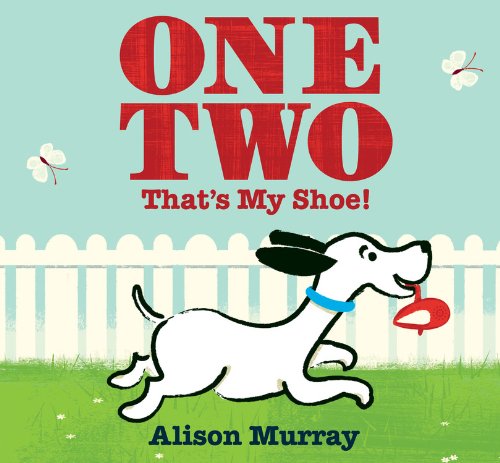
68. One Two That's My Shoe! by Alison Murray


Bibliographic Citation:
Murray, Alison. One Two That's My Shoe. New York, NY: Hyperion Books, 2012. 32 p. ISBN 978-1423143291.


Awards/Selection Lists:
None


Format Examined:
Hard cover


Annotation:
This concept book presents counting to ten through a familiar children's rhyme.


Personal Reaction:
Using the basic format of the classic children's rhyme, "One, Two, Buckle My Shoe", this book presents counting to ten as a dog runs off with a girl's shoe. The illustrations are old-fashioned, matching the old rhyme that the text is based on.

Age Recommendation:
I would recommend this book for children 2-5 years of age.


Themes/Issues:
Counting, rhyme, play


Early Literacy Skill Value:

Letter Knowledge
Numbers are presented in numeral and written word form.


Narrative Skills: 
This book follows the same format as the classic children's rhyme "One, Two, Buckle My Shoe". Children will be encouraged to participate in the narration of this story through the simple, rhyming text.


Phonological Awareness: 

The rhyming text promotes phonological awareness.


Print Awareness:

The numerals are printed in large, thick font that is centered inside a squares, and accompanied by written number words. The rhyming text of the story is printed in bold, navy blue font in empty spaces within the illustrations. 


Print Motivation: 

The familiar, rhyming text invites children to recite the words of the story, as well as count. The old-fashioned illustrations are also fun to explore.


Vocabulary:
The vocabulary in this story deals with counting to ten and telling the story of a dog who runs off with a girl's shoe. The end of the story presents word play between the word "shooo" and "shoe" as the girl shoos away a chicken as the dog holds her shoe.


Author/ Illustrator Website:

http://alisonmurray.net/

Sunday, April 21, 2013

56. Red Sled by Lita Judge


Bibliographic Citation:
Judge, Lita. Red Sled. New, NY: Antheneum Books for Young Readers, 2011. 40 p. ISBN 978-1442420076.


Awards/Selection Lists:
Kirkus Reviews, Starred Review; Best Children's Book of 2011
School Library Journal, Starred Review
Publisher's Weekly, Starred Review
CCBC Choices, 2012


Format Examined:
Hard cover


Annotation:
A group of animals borrow a child's red sled and enjoy sledding down the hill together before returning the sled to the place where the child left it.


Personal Reaction:
This nearly wordless book is a delightfully fun book. The text of the story consists of sound effects, in various font sizes and colors, that support the illustrated details of the story. Illustrations bring the animals' facial expressions to life, and the reader is able to live out the joy that they feel as they sled down the hill through the night.


Age Recommendation:
I would recommend this book for children 2-5 years of age.


Themes/Issues:
Animals, winter, borrowing, joy, fun


Early Literacy Skill Value:

Letter Knowledge
Letter knowledge is not a direct focus of this book.


Narrative Skills: 
Narrative skills are encouraged through the mostly wordless pages of this book. Children are encouraged to participate in telling the story through the details that they see in the illustrations.


Phonological Awareness: 

Phonological awareness is addressed through the use of phonological text to represent sound effects in the story.

Print Awareness:

The text of the story is printed in areas of the illustrations to show how they connect to the sounds that would take place during the action being represented.

Print Motivation: 

This book offers an entertaining look of the joy that animals would feel if they were able to ride a sled. Children will enjoy reading this book and being a part of the nearly wordless story along with creating sound effects to support the story.

Vocabulary:
Readers and children create the vocabulary for this story through describing the events in the illustrations.

Author/ Illustrator Website:
http://www.litajudge.net/

Saturday, April 13, 2013

45. Green by Laura Vaccaro Seeger


Bibliographic Citation:
Seeger, Laura Vaccaro. Green. New York, NY: Roaring Brook Press, 2012. 36 p. ISBN 978-1596433977.


Awards/Selection Lists:
Caldecott Honor, 2013
ALA Notable Children's Books, 2013
Publishers Weekly Starred Review
Booklist Starred Review
The Horn Book, Starred Review
Kirkus Reviews Starred Review
School Library Journal Starred Review

Format Examined:
Hard cover


Annotation:
This award-winning concept book represents objects and animals in varying shades of green.


Personal Reaction:
Objects and animals representing varying shades of green are revealed through the die-cut pages of this book. Acrylic painted artwork represents each object of green.


Age Recommendation:
I would recommend this book for children 2-5 years of age. 


Themes/Issues:
Green objects, shades of the color green


Early Literacy Skill Value:

Letter Knowledge
Letter knowledge is not a direct focus of this book.

Narrative Skills: 
Children are encouraged to participate in naming the green objects on each page.

Phonological Awareness: 

Phonological awareness is not a direct focus of this book.

Print Awareness:

Simple text which identifies the name of the shade of green on the page support the beautiful illustrations.

Print Motivation: 

Preschool age children will enjoy looking through the die-cut pages and viewing the beautiful illustrations of green objects on the page.

Vocabulary:
Vocabulary offered by the text of this book pertains to the different shades of green that exist through objects in the world around us.


Author/ Illustrator Website:
http://www.studiolvs.com/website_root/StudioLVS_Home/Home.html

41. The Lion and the Mouse by Jerry Pinkney


Bibliographic Citation:
Pinkney, Jerry. The Lion and the Mouse. New York, NY: Little, Brown Books for Young Readers, 2009. 40 p. ISBN 978-0316013567. 


Awards/Selection Lists:
School Library Journal Starred Review and Best Book of the Year, 2009
Publishers Weekly Starred Review
The Horn Book Fanfare Best Book, 2009
ALA Notable Children's Book, 2010
Caldecott Medal, 2010

Format Examined:
Hard cover


Annotation:
The author/illustrator uses beautiful artwork and very little words to retell Aesop's fable of a lion who spares a mouse's life and is repaid when he needs help.

Personal Reaction:
No text is needed to tell this story. Jerry Pinkney's watercolor paintings are so vivid, showing details and textures that are truly realistic. The story, a classic fable, begins with a mouse scampering across a field away from an owl, as he stumbles across the back of a lion. The lion allows the mouse to live, and later, when the lion needs help out of a net where he has been caught, the mouse climbs into the net and nibbles through to help the lion escape. The lesson represented is that of kindness to others.

Age Recommendation:
I would recommend this book for children ages 2-5 years of age.


Themes/Issues:
Kindness, showing mercy


Early Literacy Skill Value:

Letter Knowledge
Letter knowledge is not a direct focus of this book.

Narrative Skills: 
Narrative skills are a large focus of this nearly wordless book. Children are encouraged to help tell the story in their own words according to what they see happening in the illustrations.

Phonological Awareness: 

Phonological awareness is not a direct focus of this book.

Print Awareness:

Print motivation is not a direct focus of this book.

Print Motivation: 

While there is not much printed text within this book, motivation toward looking at the book, and wanting to hear the story "read" is fostered toward illustrations that are so realistic that they tell the story on their own. This timeless tale is one that children will enjoy looking at and hearing many times over.

Vocabulary:
Vocabulary is not based on printed text, but on the words that the reader shares as the story is told to the child. Kindness and mercy are two words that describe the events of the story well.


Author/ Illustrator Website:
http://www.jerrypinkneystudio.com/

39. Hide & Seek by Il Sung Na


Bibliographic Citation:
Na, Il Sung. Hide & Seek. New York, NY: Knopf Books for Young Readers, 2012. 32 p. ISBN 978-0375870781.

Awards/Selection Lists:
Booklist Starred Review, 2012
Kirkus Reviews Starred Review, 2012

Format Examined:
Hard cover


Annotation:
A group of animals decide to play hide and seek after the chameleon suggests playing, and the elephant has to find them all.


Personal Reaction:


Age Recommendation:
I would recommend this book for children 2-5 years of age.


Themes/Issues:
Counting, playing, camouflage 


Early Literacy Skill Value:

Letter Knowledge
Letter knowledge is not a direct focus of this book.

Narrative Skills: 
Listeners are invited to participate in counting from one to ten with the elephant before he seeks for each of the animals. This book provides an opportunity for dialogic reading as children try to predict which animals the elephant will find first.

Phonological Awareness: 

Phonological awareness is not a direct focus of this book.

Print Awareness:

Each of the numbers is printed large enough for the audience to see and read out together as the elephant counts.

Print Motivation: 

The beautiful artwork in combination with the game of hide and seek make this an enjoyable book for young children to revisit. The added twist of the champion hiding animal, the color-changing chameleon, also offers an opportunity for children to learn about animals who are able to change colors to blend in with their surroundings.  

Vocabulary:
The vocabulary in the story is surrounded around the types of animals that are represented in the game of hide and seek. The chameleon may be an especially new animal to children, and offers the opportunity for children to learn about color-changing animals.

Author/ Illustrator Website:
http://www.ilsungna.com/home.htm

38. The Quiet Book by Deborah Underwood


Bibliographic Citation:
Underwood, Deborah. The Quiet BookIllustrated by Renata Liwska. New York, NY: Houghton Mifflin Books for Children, 2010. 32 p. ISBN 978-0547215679.

Awards/Selection Lists:
School Library Journal Starred Review, 2010
ALA Notable Children's Book, 2011
E.B. White Read Aloud Honor, Association of Booksellers for Children, 2011
New York Times Bestseller

Format Examined:
Hard cover

Annotation:
Different types of quiet are demonstrated by different animals through gentle text and soft illustrations.

Personal Reaction:
Different emotions are paired with types of quiet which are personified through adorable animals in the illustrations of this book. The text tells children that there are different types of quiet, including being "the last one picked up from school quiet", "swimming underwater quiet", and "sleeping sister" quiet". There are happy quiets, sad quiets, scared quiets, and fun quiets. The emotions and lessons from this book are quietly meaningful.

Age Recommendation:
I would recommend this book for children 2-5 years of age.


Themes/Issues:
Being quiet, emotions

Early Literacy Skill Value:

Letter Knowledge
Letter knowledge is not a direct focus of this book.

Narrative Skills: 
The illustrations lend themselves to helping children predict what type of quiet is happening in the picture. 

Phonological Awareness: 

Phonological awareness is not a direct focus of this book.

Print Awareness:

Each line of this book is simple and appears near the bottom of most of the pages, calling attention to the connection of the printed words and the illustrations.

Print Motivation: 

The simple text and illustrations enable children to retell this story on their own. The soft, appealing illustrations are inviting for children, as well.

Vocabulary:
Words pertaining to emotions and different types of quiet provide vocabulary throughout the book.


Author/ Illustrator Website:
http://www.deborahunderwoodbooks.com/index.html

Friday, April 12, 2013

28. Have You Seen My Duckling by Nancy Tafuri


Bibliographic Citation:
Tafuri, Nancy. Have You Seen My Duckling?. New York, NY: Greenwillow Books, 1996. 14 p. ISBN 978-0688148997. 


Awards/Selection Lists:
Caldecott Honor, 1985


Format Examined:
Board book


Annotation:
A mother duck thinks the she has lost one of her ducklings and searches around the pond for him. 

Personal Reaction:
The illustrations in this book are nostalgic in color and tone, which matches the familiar storyline well. The simple repetitive text on each page matches the illustrations to help tell the story. The lost duckling appears on each page; however, in the board book version of the book, he is sometimes difficult to see.

Age Recommendation:
I would recommend this book for children 2-5 years of age.


Themes/Issues:
Family, getting lost, pond animals

Early Literacy Skill Value:

Letter Knowledge
Letter knowledge is not a direct focus of this book. 

Narrative Skills: 
The repetitive text encourages young children to take part in telling the story.

Phonological Awareness: 

Phonological awareness is not a direct focus of this book.

Print Awareness:

The phrase, "Have you seen my duckling?", is repeated in a simple, black font  throughout the book, drawing attention to the text on the pages.

Print Motivation: 

The simplicity of the story work in conjunction with the colorful illustrations of different looking pond animals to hold the attention of young children. The book's heartfelt storyline is also one that will have young children wanting to read this book again and again.

Vocabulary:
The word "duckling" may be a new word for young children. Different types of birds that may also be unfamiliar are represented in the illustrations, which may be identified by the reader.


Author/ Illustrator Website:
www.nancytafuri.com 

Saturday, March 16, 2013

17. Mouse Paint by Ellen Stoll Walsh


Bibliographic Citation:
Walsh, Ellen Stoll. Mouse Paint. Boston, MA: Houghton Mifflin Harcourt, 1995. 32p. ISBN 978-0152560263

Awards/Selection Lists:
American Bookseller's Association Pick of the Lists
International Reading Association-Children's Book Council Children's Choice
Parenting Reading Magic Award
Redbook Children's Picture Book Award


Format Examined:
Paperback 

Annotation:
Three white mice stumble across three jars of paint and discover how new colors are made through mixing the colors.

Personal Reaction:
Three white mice, who are hiding from a cat, find three jars of paint. The mice decide that the jars must be paint just for them, and decide to climb in. The white mice change colors after dipping their bodies into the jars of paint, one by one. The mice then decide to create puddles of colors on the white pages of the book. The puddles intrigue the three mice, who then decide to take turns dipping their feet into a puddle of a different color. When the mice try out the other puddles, they discover that new colors are created through mixing the colors together. The bright, bold colors on the white background, along with the matching white mice, draw young children into the story visually. Children learn about the concepts of colors and color-mixing in a fun, interactive way that combines the bold illustrations with simple yet intriguing text.

Age Recommendation:
I would recommend this book for children 2-5 years of age.

Themes/Issues:
Colors, color-mixing


Early Literacy Skill Value:

Letter Knowledge
Letter knowledge is not a direct focus of this book.

Narrative Skills: 
Color mixing vocabulary is encouraged through simple text and illustrations.

Phonological Awareness: 
Phonological awareness is not a direct focus of this book.

Print Awareness:
The text of the story is written in large black type under the illustrations on each page.

Print Motivation: 
The simple text, corresponding illustrations, and color concepts encourage children to revisit this book over and over.

Vocabulary:

Children learn color identification words through the text and illustrations on each page. 

Author/ Illustrator Website:
No official website

Saturday, February 23, 2013

9. Kitten's First Full Moon by Kevin Henkes

Bibliographic Citation:
Henkes, Kevin. Kitten's First Full Moon. New York, NY: Greenwillow Books, 2004. 40p. ISBN 978-0060588281

Awards/Selection Lists:
Caldecott Medal
ALA Notable Children’s Book
Charlotte Zolotow Award
Booklist
 Editors’ Choice
Bulletin of the Center for Children’s Books
 Blue Ribbon
Kirkus Reviews 
Editors’ Choice
Publishers Weekly
 Best Book
School Library Journal
 Best Book
New York Times
 Best Illustrated Book
Book Sense Top Ten Pick

Format Examined:
Hardcover

Annotation:
A little white kitten mistakes the moon for a big bowl of milk.

Personal Reaction:
An adorable white kitten sees the big, round moon in the sky and thinks that it is a bowl of milk. The kitten tries to lap it up, but cannot seem to reach it. Through a humorous progression of events, the kitten continues to "chase" the big bowl of milk, but cannot succeed in her quest. In the end, the kitten is rewarded with a real bowl of milk at home. The simplicity of the text paired with the black and white illustrations bring the story to life. The expressions on the kitten's face will make children chuckle. This book is a charming story that makes a perfect bedtime book for parents and children to share for many nights to come.

Age Recommendation:
I would recommend this book for children 2-5 years of age.

Themes/Issues:
Patience, nighttime, humor


Early Literacy Skill Value:

Letter Knowledge
Letter knowledge is not a direct focus of this book.

Narrative Skills: 
The repeated text, "Poor kitten" invite children to take part in telling the story as it becomes more familiar to them. The simple illustrations encourage children to retell the story in their own words.

Phonological Awareness: 
Phonological awareness is not a direct focus of this book.

Print Awareness:
The simplicity of the illustrations and bold black text on a white background calls attention to the text of the book as the story is told.

Print Motivation: 
This book tells a sweet and simple story which is perfect as a bedtime story. Children will also pick up this book to "read" on their own with simple illustrations to help them retell the story themselves.

Vocabulary:
This book prompts discussion between the reader and the listener as the kitten seeks the bowl of milk. One area of vocabulary that could be an area of focus is in defining the kittens expressions as she continues to meet new obstacles along the way.

Author/ Illustrator Website:


Sunday, February 17, 2013

5. We're Going on a Bear Hunt by Michael Rosen


Bibliographic Citation: Rosen, Michael. We're Going on a Bear Hunt. Illustrated by Helen Oxenbury. New York, NY: Mararet K. McElderry Book, 1989. 36 p. ISBN 978-0689716539 

Awards/Selection Lists:
The Horn Book Fanfare Title, 1990
School Library Journal Best Book of the Year, 1990
Boston Globe-Horn Book Honor Award

Format Examined:
Hardcover

Annotation:
A father takes his children and their dog on a bear hunt through tall grass, a river, mud, a forest, and end up in a cave with a bear.

Personal Reaction:
This classic picture book is written more like a chant than a book, which is what makes children want to hear it read over and over again. The listener goes on an adventure with the family to look for a bear. Along the way, they encounter obstacles, such as tall, wavy grass. The reader chants, "We can't go over it. We can't go under it", to which the decision is made that the family (and all the listeners, too) will have to go through it. The text on the following page mimics the sound that tall, wavy grass would make if a family were to walk through it. After the family gets through the grass, the next adventures include wading across a river, trudging through the mud, traveling through a dark, scary forest, and at last, coming to a cave. The family tiptoes into the cave, where they find "one shiny wet nose, two big furry ears, and two big goggly eyes", which is believed to be a bear! The text takes the family back through each obstacle quickly with complete sound effects, until the family arrives safely at home and hides in bed. The illustrations alternate between pencil sketches and water colored art. Color is used to identify the sound effects as the family makes their way through an obstacle. This book enables children to go on a "scary" adventure through the safety of written words and their imagination.

Age Recommendation:
I would recommend this book for children 2-5 years of age.

Themes/Issues:
Adventure, nature, sequence, sounds

Early Literacy Skill Value:

Letter Knowledge:
Letter knowledge is not a direct focus of this book.

Narrative Skills:

Children take part in the telling of this story through chanting the words on the page, and making the sound effects for each obstacle along the characters' journey.

Phonological Awareness:

Sound effects are woven into the text of the story, giving the audience the opportunity to become a part of the story through making the sounds that match the text.

Print Awareness:

The text of the story is written in simple sentences with black and white sketches. The sound effects that are made while the characters go through various obstacles are written in three lines of text that grow larger in size on each new line. Sound effect pages are accompanied by water-colored illustrations meant to draw attention to the fact that it is time for audience participation.   

Print Motivation:

Adventure and sounds make this book come to life, as it inspires imagination, thought, and reading. 

Vocabulary:

New sound words are introduced throughout this book, as well as positional words, such as over, under, around, and through. 

Author/ Illustrator Website:
Author, Michael Rosen's website: http://www.michaelrosen.co.uk/index.html
No Illustrator's website.