Showing posts with label hard cover. Show all posts

Sunday, April 28, 2013

75. The Pout-Pout Fish by Deborah Diesen


Bibliographic Citation:
Diesen, Deborah. The Pout-Pout Fish. Illustrated by Dan Hanna. New York, NY: Farrar, Straus and Giroux, 2008. ISBN 978-0374360962. 


Awards/Selection Lists:
Time Magazine's Top 10 Childrens’ Books of 2008


Format Examined:
Hard cover


Annotation:
The Pout-Pout Fish moves around the ocean with a pout on his face, and thinks it's his job to be dreary, until he learns a new lesson about the pout on his face.


Personal Reaction:
This book reveals that sometimes the things that might not seem so great about ourselves can turn out to give a lot of joy to others. The fish in this story was born with a pout, and so he thinks that it is his job to "spread the dreary wearies" all around the ocean. He meets other animals in the ocean as he swims along and they each try to cheer him up. It's not until he meets a fish who kisses him at the end of the book that he realizes that his pout can actually spread love and joy if he uses it for sharing love. 


Age Recommendation:
I would recommend this book for children 4-7 years of age.


Themes/Issues:
Grumpiness, self-acceptance, change of attitude, ocean life, love


Early Literacy Skill Value:

Letter Knowledge
Letter knowledge is not a direct focus of this book.


Narrative Skills: 
Children are invited to participate in the telling of the story through the rhyming text and the repeated refrain, "blub, blub, blub".


Phonological Awareness: 

Phonological awareness is addressed through rhyming, rhythmic text and alliteration.


Print Awareness:

The text of the story is printed in a small, simple font in the empty space in the illustrations.


Print Motivation: 

This is a fun story that children will enjoy hearing and participating in through the rhymes and sound effects that are a part of the text. The illustrations are cartoon-like, and invite children to enjoy the pictures as the story is read, or enjoy them on their own.


Vocabulary:
The vocabulary in this book is centered around different types of creations found in the ocean, as well as the moods of the Pout-Pout Fish.


Author/ Illustrator Website:
Author website: http://deborahdiesen.com/
Illustrator website: http://www.bluebellylizard.com/index.html

Saturday, April 27, 2013

74. Stars by Mary Lyn Ray


Bibliographic Citation:
Ray, Mary Lyn. Stars. Illustrated by Marla Frazee. New York, NY: Beach Lane Books, 2011. 40 p. ISBN 978-1442422490.


Awards/Selection Lists:
Starred Review, Publishers Weekly
Starred Review, School Library Journal
Starred Review, Booklist


Format Examined:
Hard cover


Annotation:
This book encourages children to observe the stars in the night sky.


Personal Reaction:
Beautiful illustrations inspire children to notice the beauty of the stars in the night. The text also encourages children to create their own stars to keep in their pockets to help them remember that they are special. 


Age Recommendation:
I would recommend this book for children 3-7 years of age.


Themes/Issues:
Nighttime, stars, observation, self-esteem


Early Literacy Skill Value:

Letter Knowledge
Letter knowledge is not a direct focus of this book.


Narrative Skills: 
Narrative skills are modeled through simple lines of text. Children are encouraged to participate in answering questions posed throughout the text.


Phonological Awareness: 
Phonological awareness is not a direct focus of this book.


Print Awareness:
The text appears in a small, simple font against a white background, which draws attention to the words printed on the page.


Print Motivation: 

This book, with its beautiful illustrations of stars in the night's sky and simple text encourages children to observe the details of stars in the night sky, as well as to connect their observations to the story. 


Vocabulary:
The vocabulary of the story focuses on the descriptions of stars as they are observed in the sky, as well as physical attributes of real and created star shapes.


Author/ Illustrator Website:
Illustrator website: http://www.marlafrazee.com/

Friday, April 26, 2013

71. No Two Alike by Keith Baker


Bibliographic Citation:
Baker, Keith. No Two Alike. New York, NY: Beach Lane Books, 2011. 40 p. ISBN 978-1442417427.

Awards/Selection Lists:
Booklist, Starred Review


Format Examined:
Hard cover


Annotation:
Two red birds play in the snow as rhyming text describes how snowflakes, nature, and people are all unique. 


Personal Reaction:
Individuality is represented through this story of two red birds who play together among the falling snow. Rhyming text describes how different the birds are from one another, as well as how snowflakes are each different, as are people and parts of nature. 


Age Recommendation:
I would recommend this book for children 3-6 years of age.


Themes/Issues:
Individuality, winter, birds


Early Literacy Skill Value:

Letter Knowledge
Letter knowledge is not a direct focus of this book.


Narrative Skills: 
Narrative skills are modeled through the rhyming text being read aloud.


Phonological Awareness: 

Phonological awareness is presented through rhyming, rhythmic text.


Print Awareness:

The text on the pages appears in small, black print on light blue and white backgrounds within the illustrations. 


Print Motivation: 

The gentle, rhyming text reads almost like a poem, and the digitally produced images provide often humorous illustrations for children to enjoy with an adult or on their own.  

Vocabulary:
Vocabulary deals with things seen in winter, as well as individuality, in nature and among people.


Author/ Illustrator Website:

70. The Biggest Kiss by Joanna Walsh


Bibliographic Citation:
Walsh, Joanna. The Biggest Kiss. Illustrated by Judi Abbot. New York, NY: Simon and Schuster, 2011. 32p. ISBN 978-1-4424-27693


Awards/Selection Lists:
None

Format Examined:
Hard cover

Annotation:
Different kisses for different animals are represented through rhyming text and colorful illustrations.

Personal Reaction:
The smallest ant and the biggest elephant all receive kisses. The rhyming text of this story about different types of kisses for different animals is combined with lively illustrations, which young children will enjoy. The rhyming format changes throughout the book, which makes the text read like a song at times.


Age Recommendation:
I would recommend this book for children 2-5 years of age.

Themes/Issues:
Parents, children, love, animals, rhyming, alliteration 


Early Literacy Skill Value:

Letter Knowledge:
Letter knowledge is not a direct focus of this book.

Narrative Skills:
The rhyming text invites children to help recite the story along with the reader as they become familiar with the words.

Phonological Awareness:
Phonological awareness is fostered through rhyming text, alliteration, and phrases, which are sometimes represented within the inside of the sentence's structure, while other times it is presented as end rhyme.

Print Awareness:
The text of the story appears in various font sizes, with the word "kiss" appearing in bold print.

Print Motivation:
The whimsy of the illustrations and the fun of the rhyming text make this a book that children will enjoy reading together with an adult.

Vocabulary:
The vocabulary of this book deals with different animals, sizes, and uses some nonsense words within the rhymes and alliteration that is presented.


Author/ Illustrator Website:

Illustrator website: http://www.giudiimages.it/

69. A Book of Sleep by Il Sung Na


Bibliographic Citation:
Na, Il Sung. A Book of Sleep. New York, NY: Knopf Books for Young Readers, 2009. 24 p. ISBN 978-0375862236.

Awards/Selection Lists:
Starred Review, Booklist
Starred Review, Publishers Weekly
Starred Review, School Library Journal


Format Examined:
Hard cover


Annotation:
An owl watches as the other animals around him go to sleep for the night.


Personal Reaction:
Beautiful illustrations and gentle text shows the perspective that an owl, who is nocturnal, has of the other animals as they sleep through the night. The owl observes the places and ways that the other animals sleep. He notices that some animals sleep standing up and that fish even sleep with their eyes open and continue moving as they sleep. The use of texture and almost chalk-like hues creates a dreamy state, which encourages sleep.


Age Recommendation:
I would recommend this book for children 3-6 years of age.


Themes/Issues:
Sleeping, nocturnal animals


Early Literacy Skill Value:

Letter Knowledge
Letter knowledge is not a direct focus of this book.


Narrative Skills: 
Children are invited to participate in identifying animals and can be encouraged by the reader to answer questions about the ways in which animals sleep.


Phonological Awareness: 

Phonological awareness is not a direct focus of this book.


Print Awareness:

The text of this book appears in small, white print against the dark background of the night sky.


Print Motivation: 

The combination of the soft illustrations and gentle text make this a good book for a bedtime reading, which children will enjoy.


Vocabulary:
The vocabulary in this book is based on the identification of animals and the places and ways in which they sleep.


Author/ Illustrator Website:
http://www.ilsungna.com/home.htm

Thursday, April 25, 2013

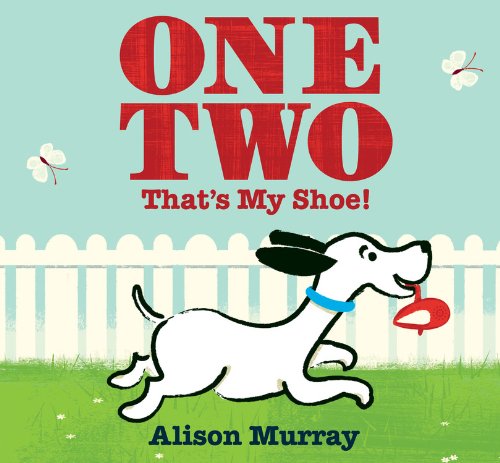
68. One Two That's My Shoe! by Alison Murray


Bibliographic Citation:
Murray, Alison. One Two That's My Shoe. New York, NY: Hyperion Books, 2012. 32 p. ISBN 978-1423143291.


Awards/Selection Lists:
None


Format Examined:
Hard cover


Annotation:
This concept book presents counting to ten through a familiar children's rhyme.


Personal Reaction:
Using the basic format of the classic children's rhyme, "One, Two, Buckle My Shoe", this book presents counting to ten as a dog runs off with a girl's shoe. The illustrations are old-fashioned, matching the old rhyme that the text is based on.

Age Recommendation:
I would recommend this book for children 2-5 years of age.


Themes/Issues:
Counting, rhyme, play


Early Literacy Skill Value:

Letter Knowledge
Numbers are presented in numeral and written word form.


Narrative Skills: 
This book follows the same format as the classic children's rhyme "One, Two, Buckle My Shoe". Children will be encouraged to participate in the narration of this story through the simple, rhyming text.


Phonological Awareness: 

The rhyming text promotes phonological awareness.


Print Awareness:

The numerals are printed in large, thick font that is centered inside a squares, and accompanied by written number words. The rhyming text of the story is printed in bold, navy blue font in empty spaces within the illustrations. 


Print Motivation: 

The familiar, rhyming text invites children to recite the words of the story, as well as count. The old-fashioned illustrations are also fun to explore.


Vocabulary:
The vocabulary in this story deals with counting to ten and telling the story of a dog who runs off with a girl's shoe. The end of the story presents word play between the word "shooo" and "shoe" as the girl shoos away a chicken as the dog holds her shoe.


Author/ Illustrator Website:

http://alisonmurray.net/

67. Animal Baths by Bob Barner


Bibliographic Citation:
Barner, Bob. Animal Baths. San Francisco, CA: Chronicle Books, 2011. 32 p. ISBN 978-1452100562.


Awards/Selection Lists:
None


Format Examined:
Hard cover


Annotation:
This simple book identifies animals and body parts through rhyming text and collage artwork.

Personal Reaction:
Bathing animals are identified through rhyming text and adorable paper collage artwork. The simplicity of the story encourages young children to participate in the identification of animals, and participate in pretend bathing. The end of the book includes each action taken by the animals in the book for children to repeat after the reading of the book.


Age Recommendation:
I would recommend this book for children 12 months-4 years of age.


Themes/Issues:
Bath time, cleanliness, animals


Early Literacy Skill Value:

Letter Knowledge
Letter knowledge is not a direct focus of this book.


Narrative Skills: 
Narrative skills are fostered through simple, colorful illustrations that encourage children to identify animals as they clean themselves. Body parts are also identified as areas that need to be cleaned during bathing.


Phonological Awareness: 

The rhyming text of this book fosters phonological awareness.


Print Awareness:

The text appears in a large font in spaces that compliment the illustrations. The color of the font changes to show against the changing background colors.


Print Motivation: 

This book is enjoyable for young children. The animals in the illustrations are very childlike, inviting children to identify them, even as they look at the book on their own. The size of the book is large, making it a nice size for children to hold in their laps.


Vocabulary:
The vocabulary of this book deals with animal identification, naming body parts, and the importance of self-help/cleanliness.


Author/ Illustrator Website:
http://www.bobbarner.com

66. The Quiet Book by Deborah Underwood


Bibliographic Citation:
Underwood, Deborah. The Quiet Book. Illustrated by Renata Liwska. New York, NY: Houghton Mifflin Books for Children, 2010. 32 p. ISBN 978-0547215679.


Awards/Selection Lists:
ALA Children's Notable Book, 2011
School Library Journal Starred Review
Publisher's Weekly Best Books, 2010


Format Examined:
Hard cover


Annotation:
Different types of "quiet" are portrayed through soft illustrations and gentle text.


Personal Reaction:
The beautiful, matte illustrations combine with simple text that expresses emotions behind different situations that animal friends experience quiet. From secrets, to hide-and-seek, to storytime, and bedtime, all different types of quiet situations are explored. The illustrations show the emotions and facial expressions of the animals during each experience. 


Age Recommendation:
I would recommend this book for children 3-5 years of age.


Themes/Issues:
Quiet, emotions, animals, friendship, self-control


Early Literacy Skill Value:

Letter Knowledge
Letter knowledge is not a direct focus of this book.


Narrative Skills: 
Narrative skills are encouraged through simple text and illustrations that incite participation.


Phonological Awareness: 

Phonological awareness is not a direct focus of this book.


Print Awareness:

The text of this book is simple and placed at the bottom of the pages. The font is small and simple, and the color of the text changes from brown to white as needed against the softly shaded illustrations.


Print Motivation: 

This book, with its soft-hued illustrations and story that young children can identify with, makes a good story for children and parents to share before bedtime, or other quiet moments. Children will also enjoy exploring this book on their own.


Vocabulary:
The vocabulary used in this book centers around experiences which require quiet behavior. This book provides a stepping off point for parents to have conversations about the importance of quiet when it is called for in certain situations.


Author/ Illustrator Website:
Author website: http://www.deborahunderwoodbooks.com
Illustrator website: http://www.renataliwska.com/

Wednesday, April 24, 2013

65. My Friend Rabbit by Eric Rohmann


Bibliographic Citation:
Rohmann, Eric. My Friend Rabbit. Brookfield, Connecticut: Roaring Brook Press, 2002. 32 p. ISBN 978-0761315353.


Awards/Selection Lists:
Caldecott Medal, 2003
ALA Notable Children's Book, 2003
Parents’ Choice Recommended
National Parenting Publications Awards (NAPPA) Gold Award


Format Examined:
Hard cover


Annotation:
Rabbit is a good friend, but he always finds a way to get into trouble, even when he is trying to help rescue his friend, Mouse.


Personal Reaction:
Bold illustrations help tell the story of Rabbit, who accidentally throws his friend, Mouse, and his airplane, up into a tree. In order to help rescue his friend, Rabbit gathers up their friends and stacks them up, one on top of the other, in order to reach Mouse. The stack of animals fall into a heap, but somehow, the airplane and Mouse are freed.  


Age Recommendation:
I would recommend this book for children 4 to 7 years of age.


Themes/Issues:
Friendship, mistakes, safety, rescue


Early Literacy Skill Value:

Letter Knowledge
Letter knowledge is not a direct focus of this book.


Narrative Skills: 
The details included in the illustrations of this book invite children to participate in the narration of this book.


Phonological Awareness: 

Phonological awareness is not a direct focus of this book.


Print Awareness:

Text is printed in simple, black font positioned to support the illustrations. Smaller text is included to enhance the story line by representing the words of Mouse as he is stuck in the airplane in the tree.

Print Motivation: 

This book is a humorous story of friendship that children will enjoy hearing and revisiting. The vivid illustrations will encourage young children to look at the book on their own, as well. 

Vocabulary:
The vocabulary in this story deals with conversation related to efforts to rescue Mouse, as well as the difficulties that Rabbit experiences.


Author/ Illustrator Website:
http://www.ericrohmann.com/

64. Go, Go, Grapes: A Fruit Chant by April Pulley Sayre


Bibliographic Citation:
Sayre, April Pulley. Go, Go, Grapes!: A Fruit Chant. New York, NY: Beach Lane Books, 2012. 32 p. ISBN 978-1442433908.


Awards/Selection Lists:
None


Format Examined:
Hard cover


Annotation:
This book showcases different types of fruits through photographs taken at farmer's markets, small grocery stores, and fruit stands. 


Personal Reaction:
Rhyming text is presented alongside photographs to identify different types of fruit. The rhythmic text describes the attributes of the various fruits in the pictures, including color, taste, and texture.


Age Recommendation:
I would recommend this book for children 3-7 years of age.


Themes/Issues:
Fruits, colors, textures, taste, nonfiction


Early Literacy Skill Value:

Letter Knowledge
Letter knowledge is not a direct focus of this book.


Narrative Skills: 
The narrative, rhythmic text invites children to participate in reading the story. Dialogic reading would also offer children the opportunity to identify fruit in the accompanying photographs.

Phonological Awareness: 
Phonological awareness is presented through rhyming text and alliteration.

Print Awareness:
Text appears in white font against colorful backgrounds, which draws attention to the printed words of the book.


Print Motivation: 

Children will enjoy the colorful pages and photographs included in this book. The rhyming text is presented in fun, rhythmic way that will have children jumping in as the story is read.


Vocabulary:
Vocabulary presented in this book is focused around different types of fruit and the way they look, feel, and taste. Children will be presented with the identification of new types of fruit.


Author/ Illustrator Website:
http://www.aprilsayre.com/

63. Squish Rabbit by Katherine Battersby


Bibliographic Citation:
Battersby, Katherine. Squish Rabbit. New York, NY: Viking, 2011. 40 p. ISBN 978-0670012671.


Awards/Selection Lists:
None


Format Examined:
Hard cover


Annotation:
Squish is a little rabbit who goes through life unnoticed and lonely, until he makes friends with a squirrel.

 
Personal Reaction:
Squish the Rabbit got his name from being small and not easily seen. This creates problems with making friends, as Squish is also quiet as well. When he begins to play by himself, a squirrel comes along and Squish decides it's time to speak up. The two become friends and Squish doesn't feel so small or lonely anymore.


Age Recommendation:
I would recommend this book for children 3-5 years of age.


Themes/Issues:
Shyness, loneliness, self-image, speaking up, friendship


Early Literacy Skill Value:

Letter Knowledge
Letter knowledge is not a direct focus of this book.


Narrative Skills: 
Narrative skills can be modeled through reading aloud with the child, and through conversation through dialogic reading.


Phonological Awareness: 

Phonological awareness is not a direct focus of this book.


Print Awareness:

The text of the story appears in areas that are free from illustrations, drawing the eye to the printed words on the page. The word "STOP" appears in large, red letters, and is often a recognizable printed word from a child's environment.


Print Motivation: 

The illustrations in this book are inviting to young children, and the characters are likable. Young children will enjoy following Squish the Rabbit as he seeks for a friend.


Vocabulary:
The vocabulary in this book deals with feelings of loneliness and friendship, modeling words dealing with these emotions for young children.


Author/ Illustrator Website:
http://katherinebattersby.com/

Tuesday, April 23, 2013

62. Color Farm by Lois Ehlert


Bibliographic Citation:
Ehlert, Lois. Color Farm. New York, NY: HarperCollins, 1990. 40 p. ISBN 978-0397324408.


Awards/Selection Lists:
None


Format Examined:
Hard cover


Annotation:
Cut-out shapes reveal colorful farm animals which are identified in text on each page.


Personal Reaction:
Animals are created through the use of cut-out shaped pages of different colors. Animals are created through the combination of each layer of pages under the cut-out page, and accompanied by matching text. This book offers learning for young children through a simple method of combined colors and shapes created from the cut-out pages.


Age Recommendation:
I would recommend this book for children 3-6 years of age.


Themes/Issues:
Shapes, colors, farm animals

Early Literacy Skill Value:

Letter Knowledge
Letter knowledge is not a direct focus of this book.

Narrative Skills: 
Children are invited to participate in the narration of the story through shape, animal, and color identification. 

Phonological Awareness: 

Phonological awareness is not a direct focus of this book.

Print Awareness:

Each animal and shape is identified through large, black, capital letters which spell out the corresponding name of each.

Print Motivation: 

Children will enjoy naming the animals, objects and colors on the page, and seeing how the pictures change as the pages are turned.

Vocabulary:
The vocabulary in the book focuses on shape, animal, and color identification.


Author/ Illustrator Website:
No official website