Showing posts with label patience. Show all posts

Thursday, April 25, 2013

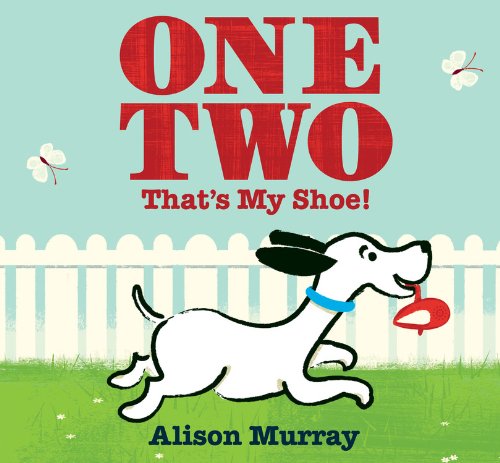
68. One Two That's My Shoe! by Alison Murray


Bibliographic Citation:
Murray, Alison. One Two That's My Shoe. New York, NY: Hyperion Books, 2012. 32 p. ISBN 978-1423143291.


Awards/Selection Lists:
None


Format Examined:
Hard cover


Annotation:
This concept book presents counting to ten through a familiar children's rhyme.


Personal Reaction:
Using the basic format of the classic children's rhyme, "One, Two, Buckle My Shoe", this book presents counting to ten as a dog runs off with a girl's shoe. The illustrations are old-fashioned, matching the old rhyme that the text is based on.

Age Recommendation:
I would recommend this book for children 2-5 years of age.


Themes/Issues:
Counting, rhyme, play


Early Literacy Skill Value:

Letter Knowledge
Numbers are presented in numeral and written word form.


Narrative Skills: 
This book follows the same format as the classic children's rhyme "One, Two, Buckle My Shoe". Children will be encouraged to participate in the narration of this story through the simple, rhyming text.


Phonological Awareness: 

The rhyming text promotes phonological awareness.


Print Awareness:

The numerals are printed in large, thick font that is centered inside a squares, and accompanied by written number words. The rhyming text of the story is printed in bold, navy blue font in empty spaces within the illustrations. 


Print Motivation: 

The familiar, rhyming text invites children to recite the words of the story, as well as count. The old-fashioned illustrations are also fun to explore.


Vocabulary:
The vocabulary in this story deals with counting to ten and telling the story of a dog who runs off with a girl's shoe. The end of the story presents word play between the word "shooo" and "shoe" as the girl shoos away a chicken as the dog holds her shoe.


Author/ Illustrator Website:

http://alisonmurray.net/

Sunday, April 7, 2013

26. When Will it be Spring by Catherine Walters


Bibliographic Citation:
Walters, Catherine. When Will it be Spring? New York, NY: Dutton Children's Books, 1997. 32 p. ISBN 978-0525458814.


Awards/Selection Lists:
None

Format Examined:
Hard cover

Annotation:
Alfie is a bear cub who doesn't want to go to sleep for the winter until he knows when spring will come. 

Personal Reaction:
Alfie's story is one that resonates with parents of children who do not want to go to bed at night. Changes in weather from fall, to winter, to spring, are taught through Alfie's experiences as he waits for spring to come. Children also learn about hibernation as Alfie's mother attempts to get Alfie to hibernate with her through the winter months. Alfie learns to be patient just in time for spring, and then falls asleep.

Age Recommendation:
I would recommend this book for children 3-5 years of age.


Themes/Issues:
Seasons, hibernation, bears, patience/waiting


Early Literacy Skill Value:

Letter Knowledge
Letter knowledge is not a direct focus of this book.

Narrative Skills: 
Children are encouraged to help tell the story through recognition of illustrations of familiar seasonal settings.

Phonological Awareness: 

Phonological awareness is not a direct focus of this book.

Print Awareness:

The text of the things that Alfie thinks he sees is printed in all capital letters in order to connect to the illustrations on the page. This draws a child's attention to the print on the page.

Print Motivation: 

This book offers an enjoyable story that children will enjoy hearing every year as they wait for spring to arrive. The illustrations are soft and subtle, and Alfie's confusion provides the opportunity for children to arrive at the correct answers before Alfie does.

Vocabulary:
Children are encouraged through the text to learn about hibernation, as well as to identify what animals and climate changes are a part of the seasons.


Author/ Illustrator Website:
No official website

Saturday, April 6, 2013

21. Growing Vegetable Soup by Lois Ehlert


Bibliographic Citation:
Ehlert, Lois. Growing Vegetable Soup. New York, NY: Voyager Books, 1987. 32 p. ISBN 978-0152325800.

Awards/Selection Lists:
Parents' Choice Gold Award

Format Examined:
Paperback

Annotation:
A father and child grow a garden of vegetables that become ingredients for vegetable soup.

Personal Reaction:
Colorful collage art is used to represent vegetables that are grown in a garden by a father and child. Each step of gardening, including planting seeds, watering, weeding, and picking/digging up vegetables is represented. Each type of plant is labeled in small print, as well as each tool. The story ends with the father and child going through each step to make a vegetable soup with the vegetables which they have grown.  A recipe for vegetable soup is included on the back cover of the book. 

Age Recommendation:
I would recommend this book for children 3-5 years of age. 

Themes/Issues:
Vegetables, growing seeds, gardening, patience/waiting, food

Early Literacy Skill Value:

Letter Knowledge
Letter knowledge is not a direct focus of this book.

Narrative Skills: 
Children can be encouraged to help tell the story as they view the illustrations for each step that is needed to grow vegetables. 

Phonological Awareness: 

Phonological awareness is not a direct focus of this book.

Print Awareness:
Simple text is represented by large, black print on the top of pages. Tools, plants, vegetables, and other objects are also labeled with small, black print on each page. This can be used to encourage children to notice print and how it connects to the story. 

Print Motivation: 
When children are encouraged to name objects represented by illustrations and text within the book, they will enjoy being a part of telling the story. Revisiting the story through growing vegetables and/or making the vegetable soup with the recipe on the back of the book can also encourage children to revisit this book. 

Vocabulary:
The names of tools, plants, vegetables, and other objects are represented by illustrations, and are labeled with corresponding words to help children learn the names of titles of the things represented on the pages.

Author/ Illustrator Website:

No official author website