Showing posts with label narrative skills. Show all posts

Saturday, April 27, 2013

73. He's Got the Whole World in His Hands (DVD)


Bibliographic Citation:
Scholastic. (2010). He's Got the Whole World in His Hands [Animate motion picture]. United States: Weston Woods Studios, Inc.


Awards/Selection Lists:
None


Format Examined:
DVD


Annotation:
This DVD includes animated "read-along" versions of seven books for children, including He's Got the Whole World in His Hands by Kadir Nelson.


Personal Reaction:
In addition to the featured book, other animated stories included on this DVD are Come On, Rain! by Karen Hesse, illustrated by Jon J. Muth; and Giving Thanks: A Native American Good Morning Message by Chief Jake Swamp, illustrated by Erwin Printup, Jr.; and Owl Moon by Jane Yolen, illustrated by John Schoenherr. The Tale of Mandarin Ducks by Katherine Paterson, illustrated by Leo and Diane Dillon; Patrick by Quentin Blake; and A Boy, a Dog, and a Frog by Mercer Mayer. The DVD is part of the Scholastic Storybook Treasures children's DVD series, which features children's books in animated form, often narrated by the author. The original artwork of Nelson's He's Got the Whole World in His Hands is presented with movement from the camera in order to bring an animated representation to the story. The text of the story is based on the classic folk song, and the printed words appear across the bottom of the screen as the words are performed by singer, Crystal Taliefero. The illustrations are rich and vivid, bringing the words of the song to life for young children.     


Age Recommendation:
I would recommend this DVD for children 3-7 years of age.


Themes/Issues:
The animated selections on this DVD represent stories that celebrate nature and the environment. 


Early Literacy Skill Value:

Letter Knowledge: 
Letter knowledge is not a direct focus of this DVD.


Narrative Skills: 
Narrative participation is modeled through the reading of each story on this DVD by a narrator, and accompanied by corresponding text across the bottom of the screen.


Phonological Awareness: 

Phonological awareness is fostered through rhyming and lyrical texts included in the stories on this DVD.


Print Awareness:

Print awareness is fostered through the inclusion of printed text along the bottom of the screen as each story is read by a narrator.


Print Motivation: 

Children will be encouraged to read along with the printed text on the screen, as well as to make connections to the printed books included on this DVD.


Vocabulary:
Vocabulary is modeled through the narration and printed text of each story included on the DVD. Vocabulary is centered around the main themes of nature and the environment.


Author/ Illustrator Website:
Author website: http://www.kadirnelson.com/
DVD website: http://store.scholastic.com/webapp/wcs/stores/servlet/LandingPageView?storeId=10052&catalogId=10051&jspStoreDir=SSOStore&pageName=StorybookTreasures

72. Buzz Buzz (Audio CD) by Laurie Berkner


Bibliographic Citation:
Berkner, Laurie. (1998). Buzz Buzz [CD]. New York, NY: Two Tomatoes Records, LLC.


Awards/Selection Lists:
None

Format Examined:
Audio music CD

Annotation:
A combination of original and traditional songs which inspire imagination, rhyme, rhythm and movement for preschool children through a combination of guitar-backed and a capella recordings.


Personal Reaction:
This music CD incorporates alliteration, rhyming, and songs that encourage movement and participation. The songs are catchy, with some familiar traditional songs. Some of the original songs encourage the use of musical instruments, and learning is tucked into the lyrics through sounds and actions.


Age Recommendation:
I would recommend this CD for use with children 2-5 years of age.


Themes/Issues:
Music, movement, rhythm, rhyming, imagination, instruments


Early Literacy Skill Value:

Letter Knowledge: 
Letter knowledge is not a direct focus of this CD.


Narrative Skills:
The songs on this CD all encourage participation, and many of the songs tell story through their lyrics, such as "The Pretzel Store", "Pig on Her Head", and "Lots of Little Pigs".


Phonological Awareness: 

Phonological awareness is embedded within lyrics through rhyming words and alliteration.


Print Awareness:

Print awareness is not a direct focus of this CD.


Print Motivation: 

The songs on this CD can be directly linked to children's books in order to encourage literacy and reading. One example is the song, "Lots of Pigs" is modeled after the classic children's story, "The Three Pigs".


Vocabulary:
Vocabulary included in the lyrics of this CD are based on preschool concepts such as positional words, rhyming, alliteration, and traditional songs.


Author/ Artist Website:
http://www.laurieberkner.com/index.php

Friday, April 26, 2013

70. The Biggest Kiss by Joanna Walsh


Bibliographic Citation:
Walsh, Joanna. The Biggest Kiss. Illustrated by Judi Abbot. New York, NY: Simon and Schuster, 2011. 32p. ISBN 978-1-4424-27693


Awards/Selection Lists:
None

Format Examined:
Hard cover

Annotation:
Different kisses for different animals are represented through rhyming text and colorful illustrations.

Personal Reaction:
The smallest ant and the biggest elephant all receive kisses. The rhyming text of this story about different types of kisses for different animals is combined with lively illustrations, which young children will enjoy. The rhyming format changes throughout the book, which makes the text read like a song at times.


Age Recommendation:
I would recommend this book for children 2-5 years of age.

Themes/Issues:
Parents, children, love, animals, rhyming, alliteration 


Early Literacy Skill Value:

Letter Knowledge:
Letter knowledge is not a direct focus of this book.

Narrative Skills:
The rhyming text invites children to help recite the story along with the reader as they become familiar with the words.

Phonological Awareness:
Phonological awareness is fostered through rhyming text, alliteration, and phrases, which are sometimes represented within the inside of the sentence's structure, while other times it is presented as end rhyme.

Print Awareness:
The text of the story appears in various font sizes, with the word "kiss" appearing in bold print.

Print Motivation:
The whimsy of the illustrations and the fun of the rhyming text make this a book that children will enjoy reading together with an adult.

Vocabulary:
The vocabulary of this book deals with different animals, sizes, and uses some nonsense words within the rhymes and alliteration that is presented.


Author/ Illustrator Website:

Illustrator website: http://www.giudiimages.it/

Thursday, April 25, 2013

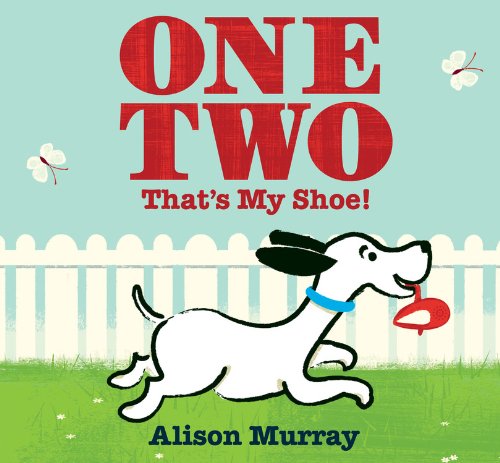
68. One Two That's My Shoe! by Alison Murray


Bibliographic Citation:
Murray, Alison. One Two That's My Shoe. New York, NY: Hyperion Books, 2012. 32 p. ISBN 978-1423143291.


Awards/Selection Lists:
None


Format Examined:
Hard cover


Annotation:
This concept book presents counting to ten through a familiar children's rhyme.


Personal Reaction:
Using the basic format of the classic children's rhyme, "One, Two, Buckle My Shoe", this book presents counting to ten as a dog runs off with a girl's shoe. The illustrations are old-fashioned, matching the old rhyme that the text is based on.

Age Recommendation:
I would recommend this book for children 2-5 years of age.


Themes/Issues:
Counting, rhyme, play


Early Literacy Skill Value:

Letter Knowledge: 
Numbers are presented in numeral and written word form.


Narrative Skills: 
This book follows the same format as the classic children's rhyme "One, Two, Buckle My Shoe". Children will be encouraged to participate in the narration of this story through the simple, rhyming text.


Phonological Awareness: 

The rhyming text promotes phonological awareness.


Print Awareness:

The numerals are printed in large, thick font that is centered inside a squares, and accompanied by written number words. The rhyming text of the story is printed in bold, navy blue font in empty spaces within the illustrations. 


Print Motivation: 

The familiar, rhyming text invites children to recite the words of the story, as well as count. The old-fashioned illustrations are also fun to explore.


Vocabulary:
The vocabulary in this story deals with counting to ten and telling the story of a dog who runs off with a girl's shoe. The end of the story presents word play between the word "shooo" and "shoe" as the girl shoos away a chicken as the dog holds her shoe.


Author/ Illustrator Website:

http://alisonmurray.net/

67. Animal Baths by Bob Barner


Bibliographic Citation:
Barner, Bob. Animal Baths. San Francisco, CA: Chronicle Books, 2011. 32 p. ISBN 978-1452100562.


Awards/Selection Lists:
None


Format Examined:
Hard cover


Annotation:
This simple book identifies animals and body parts through rhyming text and collage artwork.

Personal Reaction:
Bathing animals are identified through rhyming text and adorable paper collage artwork. The simplicity of the story encourages young children to participate in the identification of animals, and participate in pretend bathing. The end of the book includes each action taken by the animals in the book for children to repeat after the reading of the book.


Age Recommendation:
I would recommend this book for children 12 months-4 years of age.


Themes/Issues:
Bath time, cleanliness, animals


Early Literacy Skill Value:

Letter Knowledge: 
Letter knowledge is not a direct focus of this book.


Narrative Skills: 
Narrative skills are fostered through simple, colorful illustrations that encourage children to identify animals as they clean themselves. Body parts are also identified as areas that need to be cleaned during bathing.


Phonological Awareness: 

The rhyming text of this book fosters phonological awareness.


Print Awareness:

The text appears in a large font in spaces that compliment the illustrations. The color of the font changes to show against the changing background colors.


Print Motivation: 

This book is enjoyable for young children. The animals in the illustrations are very childlike, inviting children to identify them, even as they look at the book on their own. The size of the book is large, making it a nice size for children to hold in their laps.


Vocabulary:
The vocabulary of this book deals with animal identification, naming body parts, and the importance of self-help/cleanliness.


Author/ Illustrator Website:
http://www.bobbarner.com

66. The Quiet Book by Deborah Underwood


Bibliographic Citation:
Underwood, Deborah. The Quiet Book. Illustrated by Renata Liwska. New York, NY: Houghton Mifflin Books for Children, 2010. 32 p. ISBN 978-0547215679.


Awards/Selection Lists:
ALA Children's Notable Book, 2011
School Library Journal Starred Review
Publisher's Weekly Best Books, 2010


Format Examined:
Hard cover


Annotation:
Different types of "quiet" are portrayed through soft illustrations and gentle text.


Personal Reaction:
The beautiful, matte illustrations combine with simple text that expresses emotions behind different situations that animal friends experience quiet. From secrets, to hide-and-seek, to storytime, and bedtime, all different types of quiet situations are explored. The illustrations show the emotions and facial expressions of the animals during each experience. 


Age Recommendation:
I would recommend this book for children 3-5 years of age.


Themes/Issues:
Quiet, emotions, animals, friendship, self-control


Early Literacy Skill Value:

Letter Knowledge: 
Letter knowledge is not a direct focus of this book.


Narrative Skills: 
Narrative skills are encouraged through simple text and illustrations that incite participation.


Phonological Awareness: 

Phonological awareness is not a direct focus of this book.


Print Awareness:

The text of this book is simple and placed at the bottom of the pages. The font is small and simple, and the color of the text changes from brown to white as needed against the softly shaded illustrations.


Print Motivation: 

This book, with its soft-hued illustrations and story that young children can identify with, makes a good story for children and parents to share before bedtime, or other quiet moments. Children will also enjoy exploring this book on their own.


Vocabulary:
The vocabulary used in this book centers around experiences which require quiet behavior. This book provides a stepping off point for parents to have conversations about the importance of quiet when it is called for in certain situations.


Author/ Illustrator Website:
Author website: http://www.deborahunderwoodbooks.com
Illustrator website: http://www.renataliwska.com/

Wednesday, April 24, 2013

64. Go, Go, Grapes: A Fruit Chant by April Pulley Sayre


Bibliographic Citation:
Sayre, April Pulley. Go, Go, Grapes!: A Fruit Chant. New York, NY: Beach Lane Books, 2012. 32 p. ISBN 978-1442433908.


Awards/Selection Lists:
None


Format Examined:
Hard cover


Annotation:
This book showcases different types of fruits through photographs taken at farmer's markets, small grocery stores, and fruit stands. 


Personal Reaction:
Rhyming text is presented alongside photographs to identify different types of fruit. The rhythmic text describes the attributes of the various fruits in the pictures, including color, taste, and texture.


Age Recommendation:
I would recommend this book for children 3-7 years of age.


Themes/Issues:
Fruits, colors, textures, taste, nonfiction


Early Literacy Skill Value:

Letter Knowledge: 
Letter knowledge is not a direct focus of this book.


Narrative Skills: 
The narrative, rhythmic text invites children to participate in reading the story. Dialogic reading would also offer children the opportunity to identify fruit in the accompanying photographs.

Phonological Awareness: 
Phonological awareness is presented through rhyming text and alliteration.

Print Awareness:
Text appears in white font against colorful backgrounds, which draws attention to the printed words of the book.


Print Motivation: 

Children will enjoy the colorful pages and photographs included in this book. The rhyming text is presented in fun, rhythmic way that will have children jumping in as the story is read.


Vocabulary:
Vocabulary presented in this book is focused around different types of fruit and the way they look, feel, and taste. Children will be presented with the identification of new types of fruit.


Author/ Illustrator Website:
http://www.aprilsayre.com/

Tuesday, April 23, 2013

59. The House in the Night by Susan Marie Swanson


Bibliographic Citation:
Swanson, Susan Marie. The House in the Night. Illustrated by Beth Krommes. New York, NY: Houghton Mifflin Company, 2008. 40 p. ISBN 978-0618862443.


Awards/Selection Lists:
Caldecott Medal, 2009
Booklist Starred Review
School Library Journal Starred Review
Kirkus Reviews Starred Review
Publishers Weekly Starred Review


Format Examined:
Hard cover


Annotation:
Simple text combines with black, white, and gold illustrations that tell the story of a cozy house from sundown to bedtime.


Personal Reaction:
The use of black and white scratchboard art is combined with golden accents to portray a house as night comes. The text is simple and builds upon itself in a circular fashion. From a golden key, the reader enters the house with a child and her parents, and begins the nightly ritual of preparing for bed. The beauty of the night sky outside the house is shown through the illustrations, as well. The moon and the stars provide light inside the house as the child sleeps, and different aspects of life are highlighted in gold to symbolize the different things within the house that provide "light" to life.


Age Recommendation:
I would recommend this book for children 4-7 years of age.


Themes/Issues:
Nighttime, light, home, bedtime, sleeping


Early Literacy Skill Value:

Letter Knowledge: 
Letter knowledge is not a direct focus of this book.


Narrative Skills: 
Children are invited to participate in the narration of this story through simple text that builds upon itself in a circular pattern.


Phonological Awareness: 

Phonological awareness is not a direct focus of this book.


Print Awareness:

The text is represented in simple, black font which appears in the white spaces on each page. This simple method draws the eye to the printed text.
   

Print Motivation: 

The beauty of this book invites children to look for details on each page, and encourages children to revisit the book. This is a book that children will enjoy reading together with parents as part of their own bedtime routine.

Vocabulary:
The vocabulary in this book represents bedtime rituals and the beauty of nighttime.


Author/ Illustrator Website:
Author website: http://www.childrensliteraturenetwork.org/aifolder/aipages/ai_s/swanson.html
Illustrator website: http://www.bethkrommes.com/

Monday, April 22, 2013

58. Hide and Snake by Keith Baker


Bibliographic Citation:
Baker, Keith. Hide and Snake. New York, NY: Harcourt, Inc., 1991. 40 p. ISBN 978-0152339869.


Awards/Selection Lists:
None


Format Examined:
Hard cover


Annotation:
A colorful snake hides among many different brightly colored objects, inviting the reader to find him. 


Personal Reaction:
Keith Baker's vivid illustrations are paired with simple text to encourage children to seek out the snake on each page. Children become part of the story through hunting for the snake, and are encouraged to help narrate the story through its simple plot.


Age Recommendation:
I would recommend this book for children 3-7 years of age.


Themes/Issues:
Hiding, camouflage, snakes, garden


Early Literacy Skill Value:

Letter Knowledge: 
Letter knowledge is not a direct focus of this book.


Narrative Skills: 
Children are encouraged to help narrate the story through finding the snake and guessing where he might be next.


Phonological Awareness: 

Phonological awareness is highlighted through the rhyming text of the story.


Print Awareness:

The text of the story is printed in a large, simple font, dancing along the edge of the illustrations of each page. This fun way of incorporating the text draws attention to the words as they correspond with the pictures.

Print Motivation: 

This simple story, with bright illustrations, and rhyming text is fun to read and to listen to. It also provides a game of hide and seek that will engage children.


Vocabulary:
The vocabulary is centered around the things that snake hides among, and includes familiar words for young children. 


Author/ Illustrator Website:
http://www.keithbakerbooks.com/

Sunday, April 21, 2013

57. Feathers for Lunch by Lois Ehlert


Bibliographic Citation:
Ehlert, Lois. Feathers for Lunch. San Diego, CA: Harcourt Brace, 1990. 40p. ISBN 0-15-230550-5.


Awards/Selection Lists:
The Horn Book Fanfare Best Book, 1991


Format Examined:
Hard cover


Annotation:
A cat sneaks out and attempts to catch different types of birds for lunch, until he is caught by his owner.


Personal Reaction:
Text is interwoven into the illustrations on each page in order to identify flowers and birds through the story of a cat that sneaks out and is hunting for a bird for lunch. The cat misses each time, only getting a mouth full of feathers. The story ends with the cat being caught by his owner.


Age Recommendation:
I would recommend this book for children 4-7 years of age.


Themes/Issues:
Cat, bird identification, types of flowers


Early Literacy Skill Value:

Letter Knowledge: 
Letter knowledge is not a direct focus of this book.

Narrative Skills: 
Narrative skills are modeled through the text of this book about a cat hunting different types of birds. Children are invited to participate in the naming of types of birds as well as flowers identified in the story.

Phonological Awareness: 

Phonological awareness is represented through the sound of the cat's bell ringing and bird calls throughout the book. Rhyming text also fosters phonological awareness. 

Print Awareness:

Birds and flowers are identified through small text printed in various colors along the edge of the corresponding illustration.

Print Motivation: 

This book identifies birds and flowers in a fun way that combines collage and text. Children will enjoy revisiting this book and exploring types of birds and flowers. 

Vocabulary:
Vocabulary connected to bird and flower names is embedded on each page through small text printed around corresponding illustrations. A brief glossary of bird names is included at the end of the book.

Author/ Illustrator Website:
No official website


56. Red Sled by Lita Judge


Bibliographic Citation:
Judge, Lita. Red Sled. New, NY: Antheneum Books for Young Readers, 2011. 40 p. ISBN 978-1442420076.


Awards/Selection Lists:
Kirkus Reviews, Starred Review; Best Children's Book of 2011
School Library Journal, Starred Review
Publisher's Weekly, Starred Review
CCBC Choices, 2012


Format Examined:
Hard cover


Annotation:
A group of animals borrow a child's red sled and enjoy sledding down the hill together before returning the sled to the place where the child left it.


Personal Reaction:
This nearly wordless book is a delightfully fun book. The text of the story consists of sound effects, in various font sizes and colors, that support the illustrated details of the story. Illustrations bring the animals' facial expressions to life, and the reader is able to live out the joy that they feel as they sled down the hill through the night.


Age Recommendation:
I would recommend this book for children 2-5 years of age.


Themes/Issues:
Animals, winter, borrowing, joy, fun


Early Literacy Skill Value:

Letter Knowledge: 
Letter knowledge is not a direct focus of this book.


Narrative Skills: 
Narrative skills are encouraged through the mostly wordless pages of this book. Children are encouraged to participate in telling the story through the details that they see in the illustrations.


Phonological Awareness: 

Phonological awareness is addressed through the use of phonological text to represent sound effects in the story.

Print Awareness:

The text of the story is printed in areas of the illustrations to show how they connect to the sounds that would take place during the action being represented.

Print Motivation: 

This book offers an entertaining look of the joy that animals would feel if they were able to ride a sled. Children will enjoy reading this book and being a part of the nearly wordless story along with creating sound effects to support the story.

Vocabulary:
Readers and children create the vocabulary for this story through describing the events in the illustrations.

Author/ Illustrator Website:
http://www.litajudge.net/